Xactimate Estimating Guide for Contractors: How to Maximize Insurance Claim Payouts


Table of Contents
- What Is Xactimate? A Contractor-Focused Explanation
- How Does Xactimate Work? The Engine Behind the Estimate
- What Is Xactimate Used For in Restoration & Roofing Claims?
- Xactimate Carrier vs. Contractor: Why Estimates Often Clash
- Is Xactimate Accurate? Strengths, Weaknesses & Blind Spots
- How to Read an Xactimate Estimate Like a Claims Professional
- How Contractors Can Maximize Claim Payouts Strategically
- Xactimate for Contractors: Workflow from First Inspection to Final Payment
- Insurance Claim Supplements Explained for Xactimate Estimates
- How Professional Xactimate Estimating & Supplement Services Give Contractors an Advantage
- Making Xactimate Your Competitive Advantage
Xactimate is a software that needs no introduction to experts in the roofing or property restoration industry. To some, it’s just a line-item tool, while for others, it’s a constant source of friction between what a job would actually cost and the contents of an insurance estimate.
Still, some argue that Xactimate is more than just a software – it’s the language of the insurance industry where not speaking fluently can result in missed revenue and under-scoped projects. Therefore, this guide is for understanding how the software can help improve claim approvals, project speed, profit margins, and even payout reliability.
Read estimates like adjusters do, spot the missing line items, and understand why strategic estimating and professional supplement services make a world of a difference for the largest restoration firms in the country.
What Is Xactimate? A Contractor-Focused Explanation
So, what is Xactimate? In simplest terms, it’s the industry-standard estimating software that’s used in most cases by contractors and insurance adjusters. Even though some carriers use similar tools like Symbility, Xactimate remains a leading standard for property claims.
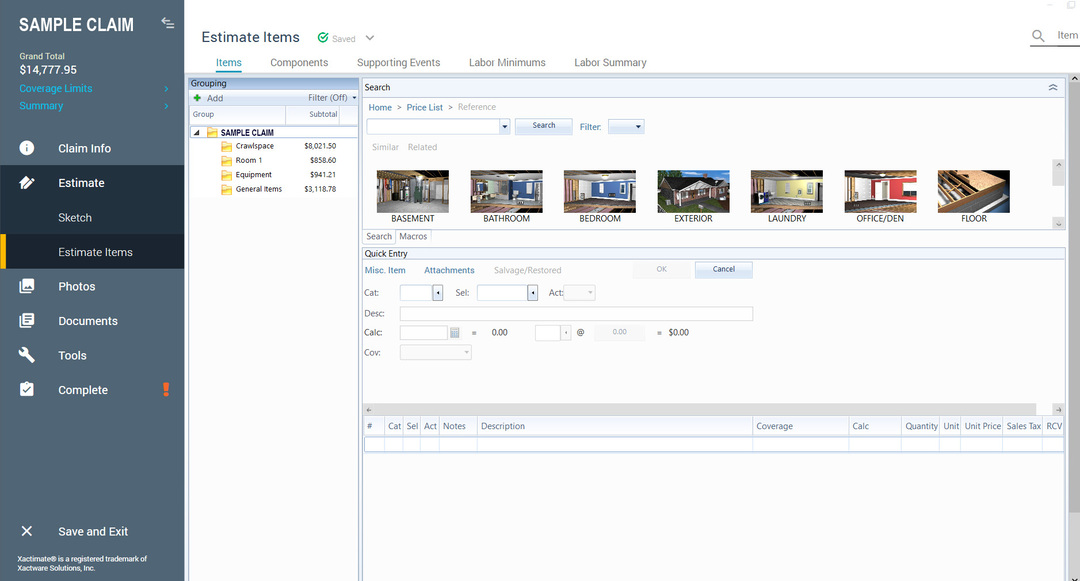
What Xactimate does is offer a centralized platform where you can sketch properties and select from more than 10K line items. Out of these, you can generate a total repair cost based on local price lists and the line-item logic applied to quantities, labor, and materials.
What is Xactimate Used For?
From the perspective of the insurance company, the software serves three purposes:
- Standardize Repair Costs and Pricing: Whether it’s a square of shingles or a gallon of paint, Xactimate seeks to ensure that the estimates will cost roughly the same within a specific area.
- Reduce Disputes: Xactimate is a third-party software, with lists updated monthly, allowing carriers and contractors to reference a shared pricing framework during discussions.
- Claim Severity Control: It allows carriers to use a framework that keeps costs predictable across the board.
What Is Xactimate Not?
- Not a Perfect Estimate: The software only provides a starting point, as it cannot see hidden damages (like mold behind walls) and is only as accurate as the information entered into it.
- Not Always Contractor-Friendly: The default settings may reflect common repair methods, and you may have to add necessary items to get the right estimate.
- Not “The Law”: Even Xactimate’s documentation and pricing guidelines note that the price list is only a guide and not a mandate. The prices shouldn’t be treated like they are set in stone.
How Does Xactimate Work? The Engine Behind the Estimate
Xactimate isn’t just a simple calculator. It’s a complex logic engine, combining labor economics, geography, and timing. How Xactimate works depends on the data fed to it, which is why your results can vary from an adjuster’s even when both parties are using the same price list.
The Pricing Database
Instead of using national average prices, Xactimate relies on:
- Regional Price Lists: The software publishes thousands of localized price lists monthly based on zip codes, factoring in local wage rates and material costs.
- Monthly Updates: The software refreshes the database every month.
- Labor + Material Logic: Every line item is a “component” made up of labor hours, material units, and equipment usage.
How Xactimate Calculates
When you choose a line item, Xactimate does not calculate a flat fee. It breaks the work down into specific components:
- Removal (&R): It calculates the labor that’s needed to remove and dispose of the damaged materials.
- Installation (&I): The cost of the replacement and the labor for installing it.
- Detach & Reset (D&R): Removing non-damaged items to perform work behind or around them, then putting them back.
- Labor Burden: The embedded costs, like basic benefits, payroll taxes, and workers’ compensation.
- Overhead & Profit (O&P): This is usually a 10/10 split (10% overhead, 10% profit). Note: Some carriers may limit O&P depending on trade complexity, etc–but for a restoration contractor managing multiple trades, it is essential to sustain operations.
Why Line Items Matter More Than Price
One issue that contractors can have with Xactimate is that the price can be too low. Usually, though, the price isn’t the problem, but the missing line items. For instance, if an adjuster gives a price for a simple drywall repair that seems low, they may have forgotten to add the costs of floor protection, masking and taping, and the costs of the primer and paint. It’s about ensuring that every single action you do is represented by a line item.
Inside the Xactimate Price List
As mentioned, the software uses regional, monthly-refreshed price lists, based on market surveys of labor and material costs in specific zip codes. While this is a solid foundation, it doesn’t always keep up with market volatility and may fail to account for complex restoration requirements.
These are the main reasons why pricing may appear low, and you shouldn’t solely rely on them. To help the case, aim to provide real-world market data and invoices to prove that the standard pricing won’t cover the real costs for specific loss conditions.
What Is Xactimate Used For in Restoration & Roofing Claims?
Xactimate is the most common shared tool for on-site damage and the check issued by the carrier. Whether it’s water mitigation, mold, storm damage, or fire restoration, the software can help document the entire project and create a defensible claim.
The standard carrier claim workflow has a set path, starting with the first inspection and an initial estimate. These are followed by a negotiation and the settlement. Many major insurance companies use Xactimate-based estimates to process payments. While some carriers utilize Symbility, Xactimate remains the primary industry tool for settling complex property claims.
In this aspect, Xactimate can:
- Improve the Accuracy of the Scope: Proper sketching ensures that every corner is accounted for.
- Justify Higher Payouts: By using Xactimate’s own line items, you can prove the necessity of specialized repairs and equipment when supported with photos, measurements, and notes.
- Prevent Underpayment: When you learn to match the carrier’s formatting, you make it less likely that adjusters will miss critical steps and line items.
Xactimate Carrier vs. Contractor: Why Estimates Often Clash
The conflicts between the two estimates usually aren’t about the software but the differences in capturing all of the damage. Carriers often initially scope based on visible damage and available documentation, while contractors may uncover additional damage once work begins.
Conflicts typically happen over higher-costs variables such as:
- Drywall Scope: Carriers may only pay for a patch, while a full sheet is required to achieve a uniform appearance.
- Detach and Reset (D&R): Contractors also include the costs of the labor to remove specific fixtures at the damaged area to complete the repair properly, and adjusters may bundle these into larger tasks.
- Flooring and Paint Blending: Some estimates may not include blending/matching unless the need is clearly documented and aligned with carrier guidelines.
- Protection and Containment: Zip-walls, floor protection, and HEPA scrubbing may get omitted from initial carrier scopes if the damage isn’t fully documented.
Scope gaps can occur when documentation is incomplete or when additional damage is discovered after the initial inspection.
Primary Reason Insurance Estimates Come in Low
Gaps between carrier estimates and true costs often stem from timing and documentation. Some adjusters may provide low prices because they are managing high claim volumes and must rely on available information at the time of inspection, which can lead to estimates that don’t reflect all jobsite conditions.
Templates are sometimes used for efficiency, but contractors are responsible for identifying job-specific needs and damages. That said, the initial estimate is never the final offer, and you should always document every real-world requirement to reduce the risk of these “shortcuts.”
Is Xactimate Accurate? Strengths, Weaknesses & Blind Spots
Yes, the software is accurate, but it’s only as precise as the data entered. If the measurements are off and the wrong line items are selected, even standard repairs can become inaccurate.
The software is great for simple and standard repairs with straightforward scopes. It can become inaccurate in complex mitigation, specialty construction, or multi-trade restoration.
When real costs exceed the estimate, it’s often due to missed line items or lack of documentation. This is where expert estimating fills the gap, making sure that the final settlement reflects actual repair costs.
How to Read an Xactimate Estimate Like a Claims Professional
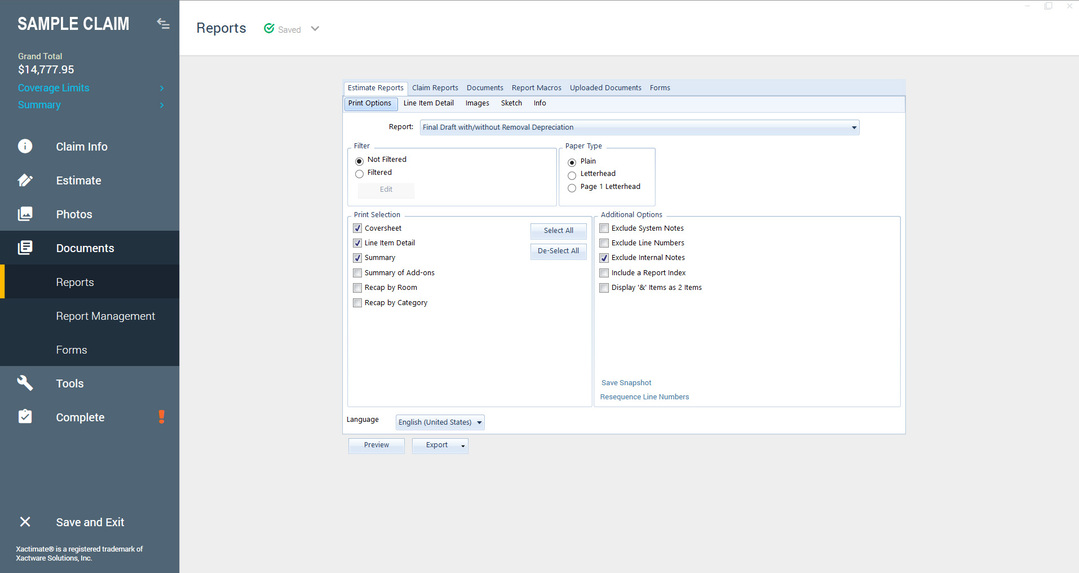
Knowing how to read an Xactimate estimate means understanding the software and the adjuster’s perspective, recognizing that adjusters must evaluate claims within policy terms and documented scope.
Here’s how the estimate structure usually looks:
- Headers: Contains claim info, price list dates, and tax settings.
- The Sketch: Ensure that the dimensions are correct.
- The Scope: Check for any missing items, accurate quantities, etc.
- Line Items: Look for specific actions with codes and descriptions.
- Totals: This is the part with the “Summary,” where Overhead & Profit (O&P) should be applied as appropriate.
How to Audit an Estimate in Under 10 Minutes
Here’s how you perform a “Gap Audit”:
- Check Room Dimensions: Compare on-site measurements with the specs in the estimate. Even small discrepancies can add up.
- Check “Bundled” Tasks: Usually, these don’t include everything. Look for missing line items for additional jobs like masking or texture matching.
- Support Test: Even if the adjuster accounted for the removal of a carpet, see whether the disposal and haul-off fees are included as well.
Xactimate Line Items Contractors Must Never Miss
Small ticket items can make the difference. Make sure that all legitimate items are included in the estimate and raise questions if they are not there.
- Environmental Controls: Zip-walls, negative air pressure setup, air filtration, etc.
- Surface Protection: RAM board or plastic floor protection for high-traffic areas.
- D&R (Detach & Reset): Wall repairs don’t include plumbing and electrical work. You must line-item D&R for:
- Toilets and sinks.
- Light fixtures and outlet covers.
- Upper and lower cabinets.
- Administrative & Site Costs: Project supervision and equipment monitoring are also overlooked unless clearly justified.
Remember, if these aren’t on the estimate, chances are, you may be paying for them.
How Contractors Can Maximize Claim Payouts Strategically
Most of the time, the claim gets underpaid because of poor documentation. That’s why it’s vital to document everything required to return the property to its pre-loss condition.
The Strategic Scoping
The documentation should be insurance-compliant, following this simple loop:
- Document: Use high-resolution photos, moisture maps, and 3D scans to prove the “why” behind every line item.
- Justify: Add notes to each line item to explain what was necessary per IICRC S500 standards where applicable.
- Align: Every line item should match the selector code and category adjusters use.
- Defend: Use the software’s own white papers and price list descriptions to counter an adjuster’s argument professionally and with job-specific evidence.
Advanced Xactimate Strategies Used by Experts
Expert estimators build a narrative around the restoration process like this:
- Sequencing: They organize the estimate by the actual workflow from mitigation to repair, making it easier for adjusters to follow the estimate, leading to faster approvals.
- Correct Labor Codes: Use the correct code for every task to avoid confusion.
- Use “Yield” Calculations: To include waste factors on roofing and flooring materials, use “yield” calculations to account for cutting and fitting in odd-shaped rooms.
- Justify Equipment: Include detailed moisture readings to prove that you did need a specific number of air movers to mitigate water damages.
Xactimate for Contractors: Workflow from First Inspection to Final Payment
Xactimate for contractors is the basis of the entire project lifecycle. Small flaws in documentation may add up to you fighting for thousands of dollars you’ve already spent.
Always inspect the site and capture the reality of the loss before you move or demolish anything. Mapping is also essential. In water damages, moisture mapping is a must for justifying drying equipment. Photo documentation is necessary for every line item you want to bill.
Also, create an exact sketch of the building in Xactimate. If the sketch is off by six inches, so will everything else be. Lastly, once you build the scope, send it to the adjuster and have your documentation ready if you need to justify anything.
On that note, documentation quality is also vital. Professional estimates with strong justification notes are more likely to get approved. Fewer disputes also mean the file will get closed sooner. Lastly, a strong initial scope will help with supplement claims as well.
Where Most Contractors Lose Money in the Xactimate Process
There are a few common leaks in the estimating process which cause profit margins to shrink. Things like rushed scoping (like not including furniture moving or detaching windows), can add up to thousands across a large loss.
Similarly, not documenting everything with photos and other evidence may force the adjuster to remove specific line items. Moisture logs should also be tied to estimates to support real costs and to justify equipment use. Using more extensive descriptions can also help justify why you needed specific help or equipment to complete a task. If an item is denied, request clarification and provide supporting documentation. Professional communication and documentation are more effective than confrontation.
Insurance Claim Supplements Explained for Xactimate Estimates
Claim supplements are requests for additional funds after the approval of the initial estimate. In these cases, supplements address newly discovered damage, code requirements, or scope revisions. Their purpose is to uncover the entire scope of work, and to deal with hidden damages.
Common Situations That Require Claim Supplements
While all jobs are different, here are some most common scenarios for supplementation:
- Hidden damages like mold or saturated insulation.
- Code upgrades when specific materials are required that weren’t in the original scope.
- Material prices increase, or availability issues make the software’s monthly price list unusable for specific materials.
- The job is complex, requiring several specialized subcontractors.
- Microbial growth that requires specialized containment and PPE is not included in the initial water mitigation estimate.
Types of Restoration Estimates Contractors Should Understand
Depending on the stage of your project, you may be working with different documents that serve very different purposes. Understanding the various types of restoration estimates is the first step toward smooth negotiations with adjusters.
- Carrier Estimates: These are baseline scopes from the adjuster. They may miss granular detail to reflect the true nature of the restoration.
- Supplemental Estimates: Course-correction documents that account for the items discovered after the work begins (or missed during the initial inspection).
When you know which estimate is which, you know how to provide documentation that the carrier’s workflow missed.
How Professional Xactimate Estimating & Supplement Services Give Contractors an Advantage
Instead of spending excessive time in negotiations, smart contractors use professional estimating services to their advantage. Outsourcing this critical task allows your team to focus on production and sales while experts handle the technical “language” of the insurance carrier.
Why Outsourcing Estimating Improves Your Bottom Line?
- Increased Profitability: Professional estimators know the software. They can find specialised line items and can document labor burdens that in-house teams often overlook or leave out.
- Faster Approval Rates: Experience also means speed. The clean, documented, and insurance-compliant estimate is harder to question, reducing the back-and-forth, and gets the project started sooner.
- Lower Administrative Burden: Your project managers can spend more time on-site because they don’t have to deal with documentation and Xactimate.
Expert estimators know exactly how to frame supplements to reduce friction with adjusters and use the carrier’s logic to justify needed payouts. Opting for this service isn’t just outsourcing a task but ensuring that you get an optimized estimate for the actual payout needed based on accurate scopes and documentation.
Should Contractors Learn Xactimate Themselves or Outsource?
Why hire experts when someone can learn to use the software in-house? The truth is that Xactimate requires perpetual learning.
It takes many hours to learn the platform’s logic and system. For a busy contractor, that time could be invested in selling new jobs or managing crews on job sites. Monthly updates and complex logic systems require the in-house expert to always remain up-to-date with the software. Not to mention, creating carrier-compliant documentation takes time and effort.
Many high-growth firms adopt a hybrid approach. They learn enough to read an estimate and spot major red flags, but they use professional third-party estimating services for the heavy lifting.
Making Xactimate Your Competitive Advantage
Xactimate is by no means an obstacle in your roofing or restoration business. It’s a useful tool that, in the right hands, can protect your margins and make sure that your work is paid fairly. Understanding the internal logic helps you justify costs, while documentation leads you to higher payouts.
Combine those with accurate supplementation, and you can account for expenses that weren’t present in the initial scope.
And in this entire process, professional estimating services are more than just expenses. This service can help speed up claim approval, and potentially act as a business growth accelerator as it stops you from leaving money on the table via poor estimates. If you are ready to maximize your business capacity, reach out to Claim Supplement Pro today.