Why Restoration Contractors and Mitigation Specialists Are Outsourcing Insurance Supplements in 2026


Table of Contents
- What Are Insurance Supplements and Why They Matter in Restoration & Mitigation Work
- Key Industry Pressures Driving Outsourcing in 2026
- Why Restoration Contractors Are Choosing to Outsource Claim Supplement Work
- Tactical Benefits Across Restoration & Mitigation Niches
- What to Look For in an Insurance Supplementing Company
- Common Misconceptions About Outsourcing Supplements
- Claim Supplement Pro’s Role in Mitigation and Restoration Claims
- Outsourcing Your Claim Supplement Process
- FAQs
- Conclusion: 2026 Is the Year to Outsource Claim Supplements
A surge in water, fire, smoke, and mold loss has pushed claim volumes higher for restoration contractors and mitigation specialists. Carriers are reviewing line items more carefully, approval timelines can take longer than expected, and documentation requirements continue to grow. With labor costs rising and experienced estimators hard to find in 2026, internal teams get stretched thin.
To help address this, many companies outsource claim supplement tasks to specialists who manage documentation, pricing, and adjuster communication. An insurance supplement adds newly discovered damage or required work to the original estimate.
External support helps mitigation specialists get paid for completed work, allowing them to focus more on field jobs and customer service.
What Are Insurance Supplements and Why They Matter in Restoration & Mitigation Work
The scope of restoration jobs may change once crews open walls or lift flooring, which is why contractors ask what are insurance claim supplements and how they protect the work already underway. A supplement updates the claim so unseen damage, code demands, and necessary repairs don’t become a financial burden for the contractor or property owner.
Companies that outsource claim supplement tasks often do so after dealing with under-documented scopes or extended approval timelines — which is why many explore in-house vs outsourced claim supplementing. The following sections walk through how supplements function on real losses and what restoration businesses stand to gain or lose depending on how they handle them.
What Is an Insurance Supplement?
An insurance supplement represents an update to the original claim estimate that lists work or damage that wasn’t included in the initial insurance estimate or that was discovered after the first inspection. Often, initial scopes miss less apparent moisture and smoke contamination within cavities.
Once demolition begins, crews frequently uncover conditions that require additional labor and materials. Understanding claim supplement processes helps restoration teams document these findings so the insurer recognizes the full cost of returning the property to pre-loss conditions.
Supplements are common in water mitigation when saturated subfloors or insulation appear after removal, in fire losses when soot spreads through HVAC systems, and in mold projects when contamination extends beyond the visible area.
They also address code upgrades and price changes in materials that surface during rebuild. Without properly submitted supplements, restoration specialists risk performing necessary work that hasn’t yet been formally approved, which can create margin pressure and project delays while revised estimates are reviewed.
The Financial and Operational Stakes for Restoration Businesses
Missing documentation on newly found damage can leave contractors footing the bill for work that wasn’t originally included. A single missed insurance supplement can turn a profitable job into a break-even project or a loss, particularly on large water or fire claims, where the full scope of the work may reveal itself after demolition.
Payment gaps delay payroll and supplier invoices. They can also require companies to adjust schedules to keep crews productive while awaiting approvals.
Projects may pause until revised estimates arrive, which frustrates property owners and disrupts production timelines.
Over time, repeated shortfalls limit a company’s ability to take on new work, invest in staff, or maintain steady operations during busy seasons.
Key Industry Pressures Driving Outsourcing in 2026
Restoration firms now face a mix of insurer demands and staffing gaps that make in-house claim handling difficult to sustain. Owners who once treated supplement work as a back-office task now see it affecting scheduling as much as client satisfaction. As a result, more teams turn to external specialists familiar with claim supplements 101 and carrier expectations.
Carrier Scrutiny and Increasing Complexity of Claims
Insurers have become increasingly detailed when reviewing estimates, questioning items that lack support or documentation. Contractors, on the other hand, often ask why some adjusters give low prices on estimates, especially when market rates for labor and materials have climbed.
Differences between desk adjusters and field adjusters can complicate approvals, since each may interpret scope or pricing differently. Internal staff rarely have time to assemble detailed justification, photos, moisture logs, and code references for every disputed item–meaning valid costs may not be approved in the initial review unless a thorough claim supplement is prepared and supported with documentation.
Payment Delays and Cash Flow Stress
Reimbursement cycles can stretch longer than the timeline most restoration companies budget for. Waiting two or three months for funds from completed work creates tension with suppliers and subcontractors who expect timely payment.
Smaller firms feel this most during storm seasons, when several large projects run at the same time. Owners searching for insurance claims covering all necessary repairs often discover that incomplete documentation early in the process leads to drawn-out approvals later, tying up money that should already be back in the business.
Growing Administrative Burden
Documentation requirements often involve more supporting material than photos and a basic estimate. Teams must track drying logs, material invoices, equipment usage, communication records, and revised scopes, then submit corrections when carriers request changes.
Office staff spends hours on emails and phone calls with adjusters, leaving less time for customer updates or new job intake. This paperwork can become a second job on top of field operations for companies that juggle dozens of open claims.
Workforce Constraints and Cost Pressures
Hiring and training estimators in-house is a significant time investment, often taking months before they can independently manage the claim process end-to-end. Turnover leaves weak points that slow the entire claims process, especially for multi-location firms that depend on consistent estimating standards. Some contractors try to divide supplement duties among project managers, but field responsibilities leave little room for complex negotiations or detailed revisions. External partners fill that gap with dedicated teams who focus solely on supplements, giving restoration companies stable support without adding permanent overhead.
Why Restoration Contractors Are Choosing to Outsource Claim Supplement Work
If you’re among those running mitigation crews or multiple restoration projects at once, you know how fast supplement files can overtake the work that brings in revenue. More than a few restoration contractors now partner with an insurance supplementing company so their field teams can bypass endless estimate revisions and carrier emails.

Reduce Administrative Overload and Free Up Internal Teams
Supplement handling involves document collection, file updates, adjuster calls, and status tracking that can stretch a small office to its limit. Outsourced specialists take over those responsibilities and keep each file moving.
Project managers no longer need to pause site visits to answer pricing questions or resend paperwork. Internal operations stay centered on production tasks such as water extraction and reconstruction planning. This is the separation that companies need to maintain service quality during regional surges in losses.
Improve Accuracy, Reduce Errors, and Avoid Rejections
External supplement teams apply consistent review methods before anything reaches the carrier. They verify measurements, confirm line items, and support pricing with documentation.
That discipline minimizes disputes and revisions. It also supports companies that produce multiple types of estimates for restoration contractors – from emergency response through final rebuild – since each phase has its own scope and billing nuances.
Shorten Claim Cycles and Improve Cash Flow
Well-prepared files go through faster because adjusters receive the information they need upfront. Supporting records, photos, and logs are organized in a way that answers common objections before they stall the process.
Faster approvals help companies close projects and redeploy crews to new losses, which matters during periods focused on maximizing storm damage claims when demand rises sharply.
Capture All Eligible Revenue Without Overhead
Many contractors discover that outsourcing pays for itself through recovered funds tied to overlooked work. Supplements often include items such as extended equipment use, hidden structural repairs, or code-required upgrades that were not in the initial scope.
External support provides this attention without adding permanent staff costs.
Outsourcing removes the need to fund:
- Additional estimator salaries
- Ongoing training for supplement procedures
- Software licenses and upgrades
- Coverage for staff absences or turnover
Tactical Benefits Across Restoration & Mitigation Niches
Outsourcing looks different depending on the type of loss and phase of work.
Water Mitigation and Scope Accuracy
Water losses rarely stay confined to the visible area. Moisture travels behind baseboards, under flooring, and into wall cavities, escalating into damage that only appears after demolition and drying begin.
Teams handling water mitigation and flood supplements must justify equipment time, antimicrobial treatments, and material removal with detailed records. External estimating services review moisture logs, photos, and drying reports to support every item they submit to the carrier. In return, this reduces disputes over whether procedures were necessary and helps mitigation specialists recover costs tied to extended drying or contamination control.
Fire and Smoke Damage — Detailed Line-Item Justifications
Fire claims involve structural damage, soot spread, odor treatment, and content cleaning that vary from room to room. Pricing often depends on the level of heat exposure and the type of materials affected.
Supplement professionals document these differences with room-by-room breakdowns and explanations for specialized cleaning methods or demolition. Their familiarity with carrier review patterns helps restoration contractors present charges in a format adjusters know well. The result is a higher chance of approval for complex restoration steps.
Mold Remediation — Uncovered Conditions and Additional Costs
Mold projects can quickly expand once containment barriers go up and materials come down. Hidden growth inside insulation, framing, or HVAC systems can add days of labor and disposal costs that were never part of the initial scope.
Specialists who manage supplements track these changes from the first containment setup through final clearance testing. They compile lab reports and disposal documentation, so additional work is recognized and paid for.
Rebuild Phases — Changes During Production
Structural repairs often reveal surprises, such as outdated wiring that’s required before reconstruction can continue. Contractors working on multiple rebuilds may struggle to document each change in real time. Outsourced supplement teams maintain communication with project managers and update carriers as new conditions appear, keeping approvals aligned with actual site progress. This ongoing coordination gives companies leeway to avoid performing extra work without reimbursement and keeps reconstruction timelines realistic.
What to Look For in an Insurance Supplementing Company
The factors below help restoration firms compare options and choose the right partner.

Technical Expertise and National Coverage
A qualified supplement partner must be knowledgeable about factors such as estimating platforms and regional pricing differences. Xactimate proficiency is just the starting point.
Teams should also understand negotiation practices, documentation standards, and that each insurer may have different claim review procedures. National coverage is important for contractors working on storm events or multi-state losses, since commercial supplements often involve larger properties and multiple adjusters reviewing the same file.
Transparent Processes and Reporting
Restoration contractors need straightforward visibility into claim progress. Reliable partners provide structured reporting, meaning project managers and owners know where each file stands.
Look for:
- Regular status summaries on open supplements
- Access to submitted estimates and supporting records
- Notes on adjuster responses and pending items
- Timelines for revisions and expected decisions
Clear Roles and Communication Practices
Supplement teams should function as an extension of the contractor’s office and have defined roles to prevent duplicated effort.
Project managers, estimators, and office coordinators should all know who gathers site information, who speaks with adjusters, and who tracks approvals. Moreover, timely communication reassures property owners who want updates on payment status tied to their repairs.
Ethical Standards and Industry Compliance
Principled supplementing protects long-term relationships with carriers and clients. Ethical partners document legitimate work and avoid inflated or unsupported charges that could create unnecessary disputes.
Compliance with industry standards is especially important on large commercial supplements, where audits and secondary reviews are more common. Contractors benefit from partners who prioritize accuracy and accountability, since those practices reduce the risk of delayed settlements or damaged reputations.
Common Misconceptions About Outsourcing Supplements
Many contractors hesitate because of assumptions about cost, control, or quality, yet most concerns come from past experiences or incomplete information about how an insurance supplement partner actually works.
“We’ll Lose Control of the Claim”
Oversight stays with the contractor when responsibilities are defined from the start. Service agreements outline who communicates with adjusters, who approves estimate changes, and how updates reach the project team.
Companies such as Claim Supplement Pro operate behind the scenes, submitting documentation and negotiating details while the contractor keeps final authority over scope decisions and client communication. Regular file reviews and shared access to correspondence ward off surprises, and allow managers to step in whenever needed.
“Outsourcing Is Too Expensive”
Cost concerns are usually about service fees, but they are not always compared to missed revenue or staff hours spent going after approvals. Companies handling every insurance supplement internally typically deal with unpaid labor, delayed reimbursements, and office staff’s overtime.
A realistic comparison should include:
- Revenue lost from incomplete or denied items
- Time staff spend revising files instead of working on new jobs
- Payroll tied to administrative follow-ups
- Delays that slow project turnover
“We Can Do It Better In-House”
Internal teams know their projects best, yet supplement work requires constant attention to carrier requirements and documentation standards. During storm seasons or busy months, staff might not have time to track every revision or respond to adjuster requests swiftly.
External specialists direct their attention solely to claim preparation and negotiation, which helps maintain consistency even when job volume spikes. Contractors still provide field information and approve changes, but they gain support from people whose only task is managing supplements from submission to resolution.
Claim Supplement Pro’s Role in Mitigation and Restoration Claims
Claim Supplement Pro supports restoration general contractors through diligent insurance supplement management, scope revisions, and carrier communication from start to finish. Project managers and estimators handle field work, rebuild coordination, and client communication, while our team manages detailed documentation, follow-ups, and adjuster communication.
Each file undergoes thorough reviews, ensuring all documented damage and applicable line items are submitted clearly and accurately.
Our team works within your existing workflow and coordinates with office staff, estimators, and production leads to gather everything, from photos to drying logs. We prepare the supporting paperwork, respond to adjuster questions, and track approvals so nothing falls through the cracks.
Restoration firms gain consistent follow-through on every claim and more predictable payment timelines without hiring additional administrative staff or training new estimators.
Outsourcing Your Claim Supplement Process
Before handing off files, take time to map how claims currently pass through your office, so the transition solves real problems.
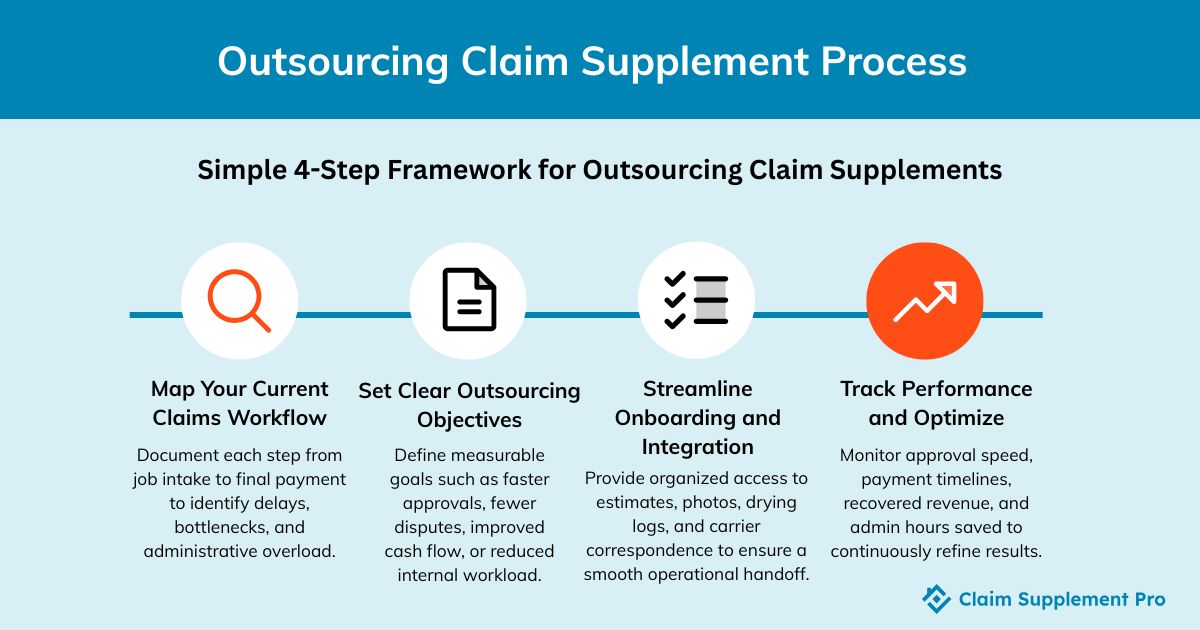
Assess Your Current Claims Workflow
Make it your priority to trace each step from job intake to final payment. Note details such as where files stall, and how long adjuster responses take.
Contractors tend to discover that a single estimator or office coordinator manages most of the claim supplement workload. That creates hold-ups when job volume increases.
Identify these choke points, as these will help determine which tasks should transfer to an external team.
Define Goals for Outsourcing
Set specific outcomes so expectations mirror results. Some companies want faster approvals, others want fewer disputes or better recovery on overlooked items.
Written goals also guide communication with the outsourcing partner and help measure progress after implementation. It’s much more difficult to judge whether the change improved operations without defined targets.
Onboarding and Integration Best Practices
Successful onboarding largely depends on organized information sharing. Provide access to estimate files, photo documentation, drying logs, and prior correspondence with carriers.
Establish who approves revisions, the process for update delivery, and when project managers should be contacted for site details. This way, you eliminate doubts from the equation once active claims enter the new system.
Monitor KPIs Post-Outsourcing
Performance tracking confirms whether the partnership meets expectations. Review payment timelines, approval rates, administrative hours redirected to production, and total funds recovered from supplements.
Regular check-ins make room for adjustments to workflow and communication so the process continues to improve as claim volume changes.
FAQs
When should a restoration contractor outsource claim supplements?
A restoration contractor should outsource claim supplement work when internal staff cannot keep up with documentation, revisions, and carrier communication without slowing project delivery or missing eligible revenue.
How does outsourcing improve claims payment timelines?
Outsourcing helps files reach adjusters with complete documentation and fewer errors, which reduces back-and-forth and speeds approvals.
Can outsourcing reduce administrative burden for mitigation teams?
Yes, teams that hand off supplement tasks spend less time on emails, estimate changes, and follow-ups, allowing them to stay focused on field operations.
What should I expect from an insurance supplementing company?
Expect structured reporting, detailed handling of each insurance supplement, consistent adjuster communication, and coordination with your office staff.
Conclusion: 2026 Is the Year to Outsource Claim Supplements
Insurance claim work has become more complex to manage in-house as documentation standards become more stringent, and back-and-forth with carriers stretches over weeks. Restoration companies are increasingly finding that shifting this portion of the process to a specialized partner frees their teams to stay on job sites.
Outsourced supplement support keeps claims moving and puts experienced negotiators on files that might otherwise stall. It also gives owners more predictable operations without adding permanent office staff.