The Contractor’s Guide to Choosing the Right Claim Supplement Company


Table of Contents
- Why Choosing the Right Claim Supplement Company Directly Impacts Your Profitability
- Step 1: Understand What You Actually Need from a Partner
- Step 2: Evaluate Technical Expertise
- Step 3: Analyze the Claim Supplement Process and Workflow
- Step 4: Compare In-House vs. Outsourced Supplementing
- Step 5: Red Flags to Watch for When Choosing a Company
- What Defines the Best Claim Supplementing Service in 2026?
- ROI Framework: Calculating the Value of Your Supplement Partner
- Contractor Decision Checklist
- Final Thoughts: Choosing a Strategic Business Partner
Insurance projects often close with a discrepancy between the work completed on site and the amount approved in the claim. The crew finishes the repairs, but the estimate still leaves money behind.
In most cases, the issue stems from weak supplement support. Parts of the repair scope never appear in the estimate, and required upgrades related to local building rules remain unaddressed. Meanwhile, the claim file fails to show everything that went into the job.
Contractor forums and industry conversations frequently place the unrecovered portion of a claim between 20% and 40% of the project value when supplementing is inconsistent or handled in-house without a clear process. The issue rarely comes down to conflict with adjusters. Most adjusters rely on the documentation presented to them and evaluate claims based on the information available.
For contractors who plan to grow, the real question becomes how to choose a claim supplement company that supports protecting revenue and strengthening the claim file from the start.
This guide walks through the decision process.
Why Choosing the Right Claim Supplement Company Directly Impacts Your Profitability
Claim outcomes often depend on how accurately the project scope appears in the estimate. The supplement partner has a say in how that claim turns out.
Their strategy affects how well the estimate represents the actual work and how the claim holds up during adjuster review.
The file represents the project more accurately when a skilled supplement partner prepares the claim with technical knowledge and organized records. Poor supplement preparation may leave part of the repair work out of the estimate.
Unfortunately, this can reduce claim revenue while simultaneously burdening project managers with unnecessary work.
The Hidden Cost of Choosing the Wrong Partner
An underperforming supplement partner creates problems that reach far beyond a weak estimate. The approved amount stays lower than the actual project cost when necessary repairs never appear in the claim.
Required upgrades related to building rules may remain unaddressed, and certain trade requirements may never enter the estimate. The operational impact can be just as serious.
Project managers may have to step in to request additional intel from the field or explain the job again to the supplement team. Adjuster conversations also take longer when the claim file lacks strong support for revisions.
Work that should reduce administrative pressure begins mounting more tasks for the internal team, pulling attention away from production and customer service.
How the Right Supplement Partner Supports Stronger Claim Outcomes
A qualified supplement partner focuses on representing the legitimate scope of work with precision and documentation. Their role is not to inflate estimates or introduce unsupported items.
The goal is to document the project accurately so that the claim file mirrors the job’s true requirements.
This approach often improves approval ratios because the claim submission includes code references, manufacturer guidance, detailed scope descriptions, and clear notes inside the estimate. Adjusters receive the information necessary to evaluate the request without extended back-and-forth communication.
Cycle times also tend to improve when the claim file is organized from the beginning. Supporting documentation, annotated photos, and technical notes help the conversation get going more efficiently.
If you need a refresher on how insurance claim supplements work, it helps to review how documentation, scope revisions, and adjuster communication all fit together in the claims process.
Supplementing should follow a structured method to represent completed work properly while keeping the claims process collaborative and professional.
Data Comparison: The Impact of Expertise
The difference between basic estimating services and a strategic supplement partner often comes down to how the supplement team prepares and presents the claim file.
| Feature / Line Item | Basic “Estimate Mill” Service | Strategic Supplement Partner |
| Overhead & Profit (O&P) | Rarely supported or easily conceded. | Strong justification and reasoning |
| Code Requirements | Mentioned generally (“as per code”). | Cited with specific IRC/IBC sections and local ordinances. |
| Documentation | Standard job site photos. | Annotated photos, ITEL reports, and manufacturer specs. |
| Adjuster Notes | Generic Xactimate descriptions. | Custom F9 notes with logical arguments for every line item. |
| Material Accuracy | Uses standard grade materials only. | Researched pricing for specialty/niche materials |
| Negotiation Style | Reactive (waits for a “No”). | Proactive (anticipates objections before submission). |
Step 1: Understand What You Actually Need from a Partner
Contractors often begin the search for supplement support after claim work starts piling up. Estimates take longer to prepare, project managers spend evenings inside Xactimate, and claim revisions span several weeks. Before selecting a company, it helps to identify the exact problem inside the current workflow.
Are You Solving a Capacity Problem or a Skill Gap?
Some companies already understand supplementing but lack the time to keep up with claim volume. Project managers may know the software and documentation standards well.
The difficulty comes from the workload. A growing pipeline of projects leaves little room to build detailed estimates and revise scopes after adjuster feedback.
Other companies face a different challenge. The team may struggle with Xactimate depth, F9 notes, or the documentation standards carriers expect.
Estimates go out quickly, yet approvals remain limited because the file lacks technical support. These situations call for different types of partners.
High-volume supplement services often operate like estimate mills. Their focus stays on speed and large claim counts.
Contractors who already know the process sometimes choose this option when they only need additional manpower. Complex claims, commercial losses, and projects involving several trades often require a more specialized partner.
A company with deeper construction knowledge and detailed documentation standards may handle those files more effectively. Identifying the true need helps narrow the search before any contract discussions begin.
Define Your Goals and Metrics
A supplement partner should support measurable business results. Establishing performance targets before hiring is beneficial in keeping the relationship focused on outcomes that matter to the company.
One useful metric involves the average claim increase after supplements. Contractors often track the difference between the carrier’s initial scope and the final approved estimate.
That number offers a practical indicator of how well the supplement process represents the full project scope. Turnaround time is another important measure.
Slow estimate preparation can delay approvals and extend project timelines. Faster and well-organized submissions tend to move through carrier review more smoothly.
Approval percentages also provide insight into supplement quality. A high approval rate suggests that documentation, scope descriptions, and supporting notes align well with adjuster expectations.
Defined benchmarks give contractors a straightforward way to evaluate partner performance over time. The goal is a process that supports accurate scopes and a manageable workload for the internal team.
Contractor table example:
| Internal Challenge | Desired Outcome | Metrics to Track |
| Low Approval Rate | Consistent acceptance of O&P and code items. | % of supplement line items approved. |
| Delayed Payments | Faster cash flow and job closing. | Average days from submission to approval. |
| Owner/PM Burnout | Focus on sales and production, not Xactimate. | Weekly hours saved per project manager. |
| “Empty” Carrier Scopes | Full recovery of project costs | Average percent increase per claim. |
Step 2: Evaluate Technical Expertise
A skilled supplement partner lays out the scope in the claim file so adjusters understand the work behind the estimate. Estimating software, construction knowledge, and documentation standards all influence the final scope submitted to the carrier.
A partner with robust technical capabilities prepares estimates that reflect the project in detail and communicates effectively with adjusters.
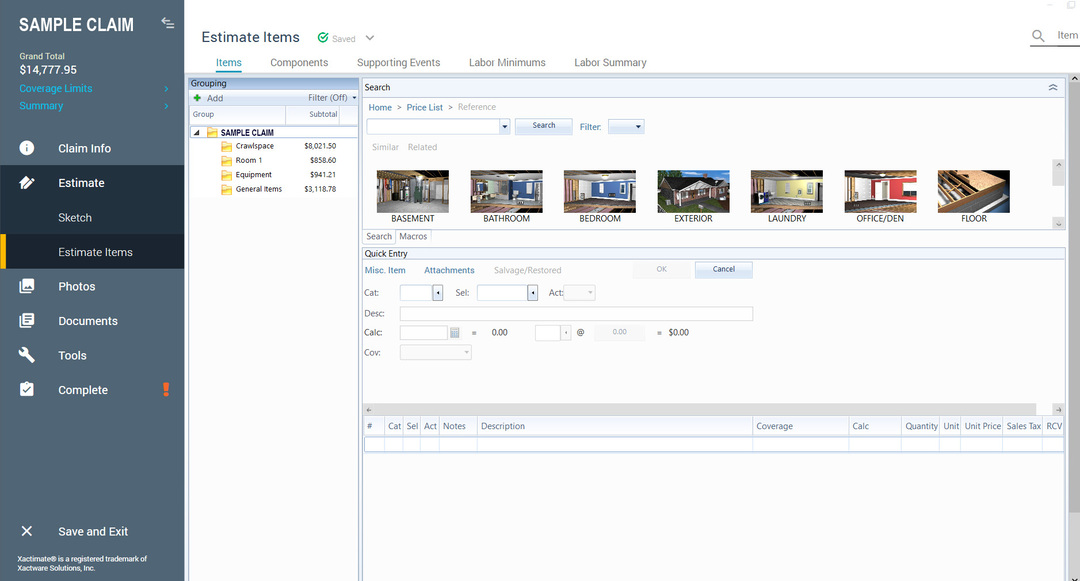
Xactimate & Symbility Mastery
Professional supplement teams treat estimating platforms as more than simple pricing tools. Xactimate and Symbility contain extensive line items, regional price lists, and detailed documentation fields that support the scope of work.
F9 notes play an important role in this process. These notes explain why each line item belongs in the estimate and provide context that helps adjusters evaluate the scope.
Without these explanations, estimates may appear incomplete or confusing. Proper use of F9 notes also helps prevent repeated revision requests.
Line item depth is also vital. Estimates that depend on basic assemblies often overlook project details such as specialty materials or preparation work.
Experienced supplement teams develop scopes that match the full sequence of tasks involved in the repair.
Regional price lists contribute to greater complexity. Local cost differences affect labor and material pricing. When needed, skilled estimators adjust scopes based on the appropriate price list and project conditions. Contractors who want to understand how to maximize insurance claim payouts often discover that technical estimate depth plays a major role in claim outcomes.
Code Compliance & Building Knowledge
Insurance carriers often request documentation that supports code-related upgrades. A supplement partner with construction knowledge understands where these requirements apply and how to document them correctly.
The International Building Code (IBC) and International Residential Code (IRC) provide guidance for numerous repair scenarios. When an estimate references the relevant section and includes supporting documentation, adjusters can analyze the claim with greater confidence.
Manufacturer installation instructions also serve as important documentation. Roofing systems, siding assemblies, insulation requirements, and ventilation standards often depend on manufacturer guidance.
This type of documentation becomes especially important when projects involve insulation upgrades or other building envelope components. Contractors sometimes review case examples, such as achieving code-compliant insulation coverage, to understand how proper documentation can influence carrier approval decisions.
Handling Complex and Multi-Trade Losses
Simple roof replacements often involve a limited number of trades and a straightforward estimate structure. Larger projects present a different challenge.
Siding losses, interior water damage, or storm events affecting several areas of a property require coordination between multiple trades. The estimate must account for demolition, structural repairs, insulation, finishes, and specialty materials. Each element needs adequate documentation and justification within the claim file.
Supplement teams with experience in complex projects understand how these scopes interact. Their estimates organize work sequences and document each trade’s involvement in the repair process.
This level of detail supports securing accurate claim coverage when the project includes multiple repair categories. Contractors often see the difference in real project outcomes, including cases that turn an incomplete estimate into a documented roof claim success supported by detailed scope documentation.
Step 3: Analyze the Claim Supplement Process and Workflow
A supplement partner’s internal process often determines how steadily claims move through review. Documentation standards, revision handling, and communication structure all contribute to the final result. Contractors expecting reliable claim outcomes usually spend time analyzing how a supplement company manages its workflow.
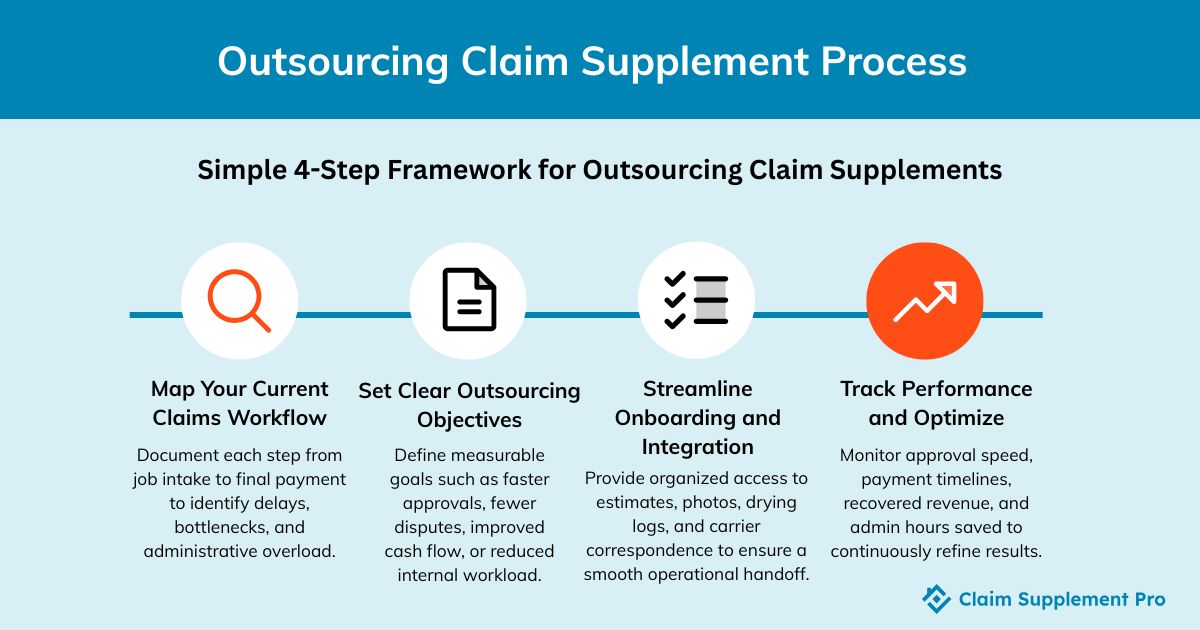
The Intake Standard: Documentation is King
Strong supplement work begins with a structured intake process. A professional partner collects detailed project information before any estimate is prepared. Without that foundation, even the most experienced estimator can’t represent the job accurately.
A thorough intake checklist often includes a complete photo set from the job site, with images that document damage areas, material conditions, and work zones. Photos usually follow specific guidelines that show scale, angles, and surrounding components.
This documentation helps adjusters get a better understanding of what occurred at the property.
Other materials may also appear in the intake file. Moisture maps from mitigation projects help document water intrusion areas and drying progress.
ITEL reports identify material types and confirm replacement requirements. Manufacturer specifications can support installation methods or product compatibility.
A company often stands out as the best claim supplementing service when it identifies incomplete documentation and requests additional info before preparing the estimate. Strong intake standards protect the entire claim file from the start.
Turnaround Times and Revision Strategy
Turnaround time matters, though speed alone doesn’t guarantee a strong estimate. Some contractors tend to focus on how fast the first draft appears. Revision handling often tells a more important story. Carriers may request clarification or question certain line items during claim review.
A supplement partner should respond with documentation, scope explanations, and detailed estimate notes that support the requested revisions.
A structured revision process keeps the claim moving without setbacks. Contractors researching how to choose a claim supplement company support often ask how revision requests are handled and how quickly updated estimates return to the adjuster.
Communication Protocols
Communication structure also influences the overall experience. Some supplement services operate through general help desks where contractors speak with a different representative each time.
Other companies assign a dedicated account manager who follows each claim from intake through final approval. This approach helps maintain continuity throughout the project and reduces repeated explanations about job details.
A consistent point of contact also helps coordinate documentation requests and adjuster communication. Contractors typically find that this structure keeps projects organized while limiting confusion between project managers, estimators, and supplement staff.
Step 4: Compare In-House vs. Outsourced Supplementing
Contractors eventually face the same operational decision: build an internal supplement department or work with an outside partner. The discussion around in-house vs. outsourced supplementing often depends on claim volume, staff expertise, and the amount of administrative work the company can realistically manage.
When In-House Might Make Sense
Internal supplement teams usually appear inside large companies with established procedures and dedicated estimating staff. These organizations may already maintain written SOPs, structured documentation standards, and project managers who spend a significant portion of their time inside estimating software.
A setup like this can function when claim volume remains high enough–and increases are profitable enough–to justify full-time estimators and administrative oversight. The company also needs team members who understand pricing databases, construction codes, and the documentation carriers ask for during claim review.
Even with those resources, internal teams still require training, software management, and regular estimate review.
When Outsourcing Is the Smarter Move
When creating estimates and negotiating with adjusters starts to compete with sales, production, and customer communication, it’s time to consider outsourcing.
This scenario appears often among restoration contractors and mitigation specialists who want project managers focused on jobs and client relationships. An experienced partner can maneuver documentation and adjuster responses while the contractor focuses on operations.
Contractors who compare supplement partners carefully often find that the best claim supplement company functions as an extension of the internal team while removing a large portion of the administrative workload.
Step 5: Red Flags to Watch for When Choosing a Company
Selecting a supplement partner requires careful evaluation of how the company operates. Certain warning signs often indicate poor practices or unreliable service.
Overpromising and “Guarantees”
Any company that advertises “100% approval” deserves close scrutiny. Insurance claims involve documentation review, policy interpretation, and adjuster evaluation. No supplement provider controls every part of that process.
Promises of guaranteed approvals may signal aggressive tactics or unsupported estimate items. Contractors should look at how a company documents scopes and communicates with carriers.
A responsible supplement partner focuses on clear-cut project representation and strong documentation within the claim supplement process, not unrealistic promises.
Lack of Pricing Transparency
The fee structure also deserves attention before signing an agreement. Some companies charge a flat rate per estimate, while others use a percentage of the approved claim value.
Both models can work, though the terms must remain transparent. Contractors benefit from knowing how the service fee relates to claim results and how costs appear on the final invoice. A clear explanation of pricing prevents confusion once claims move through approval and payment.
Poor Adjuster Communication Reputation
Relationships with adjusters are essential in insurance work. A supplement partner who communicates aggressively or dismisses adjuster concerns can damage those relationships over time.
Professional supplement teams maintain a respectful tone while presenting documentation that supports the scope of work. Clear communication backed by detailed estimate notes and photos, as well as code references, can keep claim discussions productive.
What Defines the Best Claim Supplementing Service in 2026?

Data-Driven Strategies
Insurance claim outcomes often depend on whether documentation meets carrier expectations. Experienced supplement teams study past approvals, revision patterns, and adjuster feedback related to specific carriers.
This info is necessary for estimators to prepare scopes that address common questions before the file reaches review.
Carrier tendencies may include frequent requests related to documentation detail, code references, or material verification. When estimators understand those patterns, they can prepare estimate notes and supporting documents that respond to likely concerns early in the claim supplement process. Contractors who research how to choose a claim supplement company often notice that experienced partners rely on this type of historical claim data.
Technology and Integration
Modern supplement teams also rely on technology to manage documentation and project information. Scope validation tools help confirm that estimates match job site conditions and project photos. Integrated systems connect claim files with contractor CRMs so that documentation, revisions, and communication remain organized throughout the claim lifecycle.
Companies such as Claim Supplement Pro place strong emphasis on structured documentation and digital workflow tools. These systems help estimators evaluate scope details, track revisions, and respond to adjuster questions more aptly while keeping the claim file in order from submission through approval.
ROI Framework: Calculating the Value of Your Supplement Partner
Contractors often evaluate supplement services through service fees alone. A more useful approach looks at claim performance over time. The financial effect is typically visible when claims increase, and monthly job volume enters the calculation.
A simple formula helps illustrate this relationship:
(Average Increase per Claim × Monthly Volume) − Service Fee = Net Profitability Increase
Example: a contractor completes 20 insurance jobs each month. Supplements increase the approved claim total by an average of $3,000 per project.
That equals $60,000 in additional claim value before service costs. After the supplement fee, the remaining amount reflects the added revenue tied to stronger documentation and estimate support.
This framework helps contractors measure supplement services as a business decision linked to project revenue.
Contractor Decision Checklist
Contractors often review several supplement providers before making a decision. A short checklist can help compare companies and keep the evaluation centered around practical criteria related to claim results and operational support.
The following questions summarize the key factors discussed throughout this guide.
- Do they support estimates with code references from sources such as IRC or IBC when the project scope requires it?
- Does their pricing structure remain transparent, with fees that align with measurable claim results and documented scope changes?
- Can their team manage complex projects, including commercial losses or repairs involving multiple trades?
- Do they follow a structured intake process that includes detailed photos, documentation standards, and organized claim files?
Final Thoughts: Choosing a Strategic Business Partner
Insurance claims influence more than the final estimate. They affect margins and staff workload, but also how easily projects move from approval to payment. A supplement partner is vital in that process.
Contractors who take the time to understand how to choose a claim supplement company often approach the decision as a long-term business relationship. Strong documentation standards, organized communication, and construction knowledge help produce reliable claim files in all projects.
Ready to see how a structured, expert-led approach changes your bottom line? Explore our professional claim supplement services and learn how an experienced supplement partner can support consistent claim performance across your insurance jobs.