How Third-Party Supplementing Helps Restoration GCs Get Paid Faster


Table of Contents
- What Is Third-Party Supplementing in Restoration? (And Why Contractors Are Turning to It)
-
6 Key Benefits of Third-Party Supplementing That Accelerate GC Payment Timelines
- #1 — Xactimate Expertise That Minimizes Adjuster Pushback
- #2 — Faster Approval Rates Through Strong File Preparation
- #3 — Reduced Underpayments and Higher Final Payouts
- #4 — Freed-Up Internal Resources and Operational Efficiency
- #5 — Improved Cash Flow Through Faster Project Closeouts
- #6 — Scalability Without Proportional Overhead Growth
- Common Strategies Third-Party Supplementors Use to Maximize and Accelerate Your Claim Payouts
- What Does the Third-Party Supplement Process Actually Look Like for a Restoration GC?
- Typical Timeline: How Long Does Third-Party Supplementing Take?
- How to Choose the Right Third-Party Supplement Company
- The Supplement Advantage Starts Here
A $30,000 job gets done, and the insurer pays $18,000. That shortfall holds back cash flow and final payment, all while cutting into the job’s margin.
Initial insurance estimates frequently fall short of the full scope, which is why third-party supplementing for restoration contractors is among the vital components in narrowing that gap.
This guide covers what supplementing involves, how it shortens payment timelines, how supplement companies operate, the strategies they use, how to evaluate them, and some next steps.
What Is Third-Party Supplementing in Restoration? (And Why Contractors Are Turning to It)
Third-party supplementing means enlisting an outside specialist to evaluate an insurance estimate and pick up on the missed or undervalued costs. They would also negotiate revisions with the carrier on the contractor’s behalf.
These revisions (known as insurance supplements) adjust the original estimate so it equals the project’s true scope and price. Contractors who want a deeper explanation can read our guide on what insurance supplements are.
Gaps are often present because insurance estimates may miss required building upgrades, specialized trades, material price fluctuations, regional labor rates, or overhead and profit (O&P). The result is typically an initial payout that’s at odds with the completed work.
Supplementing is a standard part of the insurance claim process. Contractors, carriers, and adjusters handle supplements every day across roofing, fire, storm, and mitigation work.
Contractors can handle supplements internally or hire a dedicated company. Internal teams analyze estimates and submit revisions or manage adjuster communication themselves.
Third-party specialists take on that role as an outsourced service. Our comparison of in-house vs outsourced claim supplementing explains how those two approaches differ and when each one fits a contractor’s operation.
6 Key Benefits of Third-Party Supplementing That Accelerate GC Payment Timelines
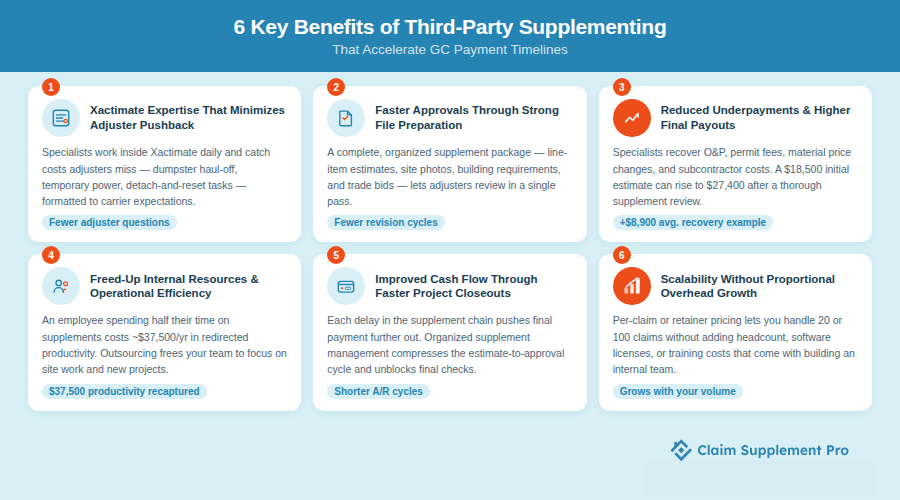
#1 — Xactimate Expertise That Minimizes Adjuster Pushback
Xactimate is the estimating platform most carriers use when they gauge property damage claims. Some adjusters may lack expertise with the software’s pricing structure, category logic, and line-item conventions, so they create estimates that overlook part of the project’s total.
Third-party supplement specialists work inside this system on a daily basis. They can recognize the costs that adjusters may sometimes accidentally leave out or reduce.
Dumpster haul-off, temporary power, or detach-and-reset tasks related to contents or fixtures are among some common examples. Adjusters will spend less time questioning the scope when these items are in the estimate with the appropriate documentation.
Companies that offer estimating services within the restoration industry also support insurance claim supplementing restoration work by producing Xactimate estimates that are in line with the carrier’s format expectations.
#2 — Faster Approval Rates Through Strong File Preparation
During busy times, adjusters analyze hundreds of claims each month. A supplement file that comes organized and complete is bound to get attention sooner than one that requires repeated clarification.
A successful supplement package tends to include a meticulous line-item estimate, site photos pointing to specific tasks, local building requirements, and subcontractor bids when specialized trades enter the project. Each of these elements creates a foundation for the requested scope and gives the adjuster enough context to appraise the request without too many follow-ups.
The adjuster can complete the review in a single pass when the file contains everything required to support the revision. That reduces extended email threads and multiple revision cycles.
#3 — Reduced Underpayments and Higher Final Payouts
Initial insurance estimates often land well below the restoration’s true cost.
Supplement specialists focus on locating the categories that tend to disappear in early estimates. Those categories often include O&P, building upgrades related to local requirements, permit fees, material price changes, extended site supervision, or specialized subcontractor tasks.
Let’s take a simple roofing example to illustrate this difference.
An insurer may approve an initial estimate of $18,500. After a supplement review adds O&P, drip-edge, roof decking replacement, and other needed items, the claim value rises to $27,400.
Contractors who face similar situations often ask what to do in the case of the insurance claim underpayment, which is exactly the situation supplements address.
#4 — Freed-Up Internal Resources and Operational Efficiency
Insurance supplements demand time and attention. Emails with adjusters, estimate revisions, status checks, and resubmissions can stretch across weeks or even months.
When that work stays inside the company, experienced project managers or office staff can spend hours on tasks that produce no new revenue. An employee earning $75,000 per year who spends half of their schedule handling supplements represents roughly $37,500 in redirected productivity.
Third-party specialists take care of adjuster communication, revision submissions, and follow-ups as part of their service. Contractors who explore outsourcing insurance supplements often do so because their internal staff needs to stay focused on site work and new project intake.
#5 — Improved Cash Flow Through Faster Project Closeouts
Delayed supplements hamper claim completion. The final payment often remains pending when the carrier hasn’t approved the revised estimate.
Two-party checks wait and depreciation releases stall. Meanwhile, accounts receivable stretch well beyond the end of construction.
The timeline typically looks like this:
Initial insurance estimate → Supplement submission → Adjuster response → Additional negotiations → Approval → Final check release.
Each delay in that chain pushes payment further into the future. Contractors who search how to get paid faster on insurance claims tend to find that organized supplement management plays a major role in shortening this cycle.
#6 — Scalability Without Proportional Overhead Growth
As restoration companies expand, supplement volume grows along with job volume. A contractor handling 20 insurance claims per year faces a very different workload once the company reaches 80 or 100 projects.
Hiring internal supplement staff brings added salary, benefits, training time, and estimating software licenses. Third-party supplement firms operate on a per-claim or retainer structure, which allows contractors to work with higher claim volume without expanding internal headcount.
Every contractor that aims for a more complex comparison should go through in-house-vs-outsourced-claim-supplementing resources to evaluate which structure best supports their growth plans.
Common Strategies Third-Party Supplementors Use to Maximize and Accelerate Your Claim Payouts
Line-Item Audit — Identifying What the Initial Estimate Left Out
A supplement review typically begins with a detailed audit of the adjuster’s estimate. Specialists compare the carrier’s version with site photos and the contractor’s scope of work.
The goal is to identify costs that failed to make it into the original estimate – including items that were underpriced.
This audit step may reveal missing O&P, labor rates that rely on national averages rather than local pricing, excluded materials such as drip edge, or early project phases like pre-demo inspection and containment. These corrections explain how third-party supplementors increase necessary and legitimate claim payouts.
Basically, they locate the work already required to complete the job but are absent from the initial estimate.
10 Line Items Adjusters Commonly Omit in Restoration Estimates
- Overhead & Profit (O&P)
- Building upgrades required by the local jurisdiction
- Temporary protection (tarps, board-up)
- Debris removal and dumpster haul-off
- Permit fees and inspection costs
- Contents manipulation and pack-out
- Detach and reset for existing fixtures (appliances, cabinetry)
- Extended general conditions on longer projects
- Material price escalation during storm surges
- Specialized subcontractor work, such as mold, biohazard, or structural repair
Proactive File Submission — Front-Loading Approval
Supplement specialists prepare a complete submission before the adjuster asks for additional support. On average, the file includes a revised Xactimate estimate, site photos of specific tasks, building requirement citations, and subcontractor bids tied to licensed trades.
An adjuster who receives a structured file can evaluate the revision without repeated requests for additional information. Fewer questions, naturally, lead to fewer revision cycles and faster claim decisions.
Assignment of Benefits (AOB) Strategy — Directing Payment to the Contractor
Assignment of Benefits allows a policyholder to transfer insurance payment rights to the contractor who performed the work. With this agreement in place, the contractor collects payment directly from the carrier.
This arrangement prevents delays related to homeowner endorsement of two-party checks or banking holds. State laws govern how AOB agreements work, and regulations vary widely. Contractors are the ones who analyze local rules and consult legal counsel before using this option.
Adjuster Communication Management — Reducing the Back-and-Forth Cycle
Third-party supplement teams are in charge of communication with the carrier during the entire claim review process. Adjuster questions, estimate revisions, and follow-up requests pass through the supplement specialist rather than the contractor’s office.
Specialists also anticipate common objections. When O&P doesn’t appear in the estimate, for example, the supporting explanation often accompanies the submission from the start.
Each avoided communication cycle can save a week or more, which shortens the overall timeline between supplement submission and claim approval.
What Does the Third-Party Supplement Process Actually Look Like for a Restoration GC?
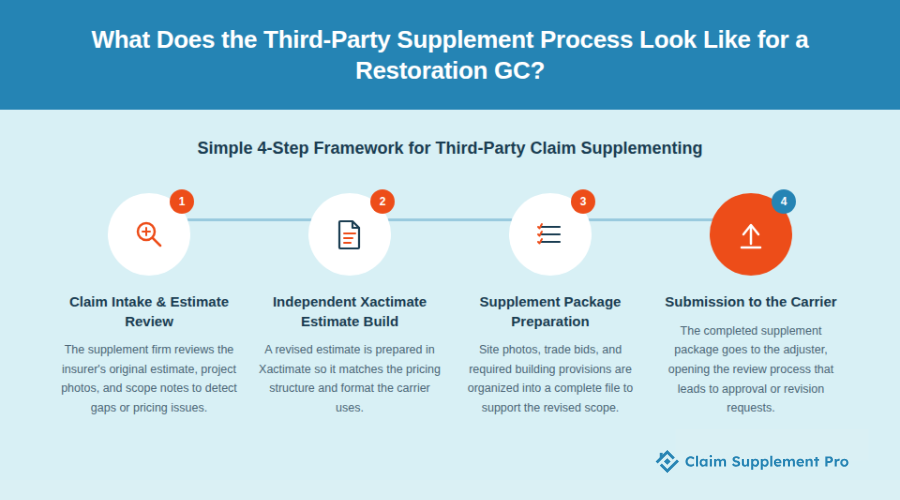
Contractors often want a practical view of how outside supplement support fits into an active claim. The process behind third-party supplementing for restoration contractors follows a structured workflow that matches the carrier’s review process and the contractor’s project timeline.
- Claim intake and estimate review — The supplement firm reviews the insurer’s original estimate, project photos, and scope notes to detect gaps or pricing issues.
- Independent Xactimate estimate build — A revised estimate is prepared in Xactimate so it matches the pricing structure the carrier uses.
- Supplement package preparation — Supporting materials (e.g., site photos, trade bids, and required building provisions) are organized to support the revised scope.
- Submission to the carrier — The completed supplement package goes to the adjuster, opening the review process that leads to approval or revision requests.
Typical Timeline: How Long Does Third-Party Supplementing Take?
GC Handling Internally
| Third-Party Supplement Firm
|
How to Choose the Right Third-Party Supplement Company
Not every supplement firm delivers the same results. Experience, estimating accuracy, and adjuster communication practices can vary widely across providers. Contractors who invest time in choosing the right claim supplement company get the benefit of fewer delays and more robust claim outcomes.
Key factors to review include:
- Xactimate expertise — strong expertise with line-item logic and carrier pricing structures
- Adjuster communication management — straightforward handling of emails, revisions, and follow-up
- Escalation process — a defined path when disputes with the carrier arise
- Pricing model alignment — fee structure that considers the contractor’s margins
The Supplement Advantage Starts Here
Restoration contractors who rely only on the adjuster’s initial estimate often leave much of their rightful payment unrecovered. Third-party supplement support works as a revenue recovery tool and an operational support system at the same time.
Contractors who understand the supplement process (whether handled internally or through outside services such as professional estimating services) start each claim discussion with stronger numbers and better preparation.