Category 1 vs 2 vs 3 Water Damage: What Adjusters Look For

Table of Contents
- Quick Refresher: What Are Water Damage Categories?
- Why Water Category Classification Directly Impacts Your Claim Payout
- What Adjusters Look For When Determining Water Category
- The Carrier Downgrade Playbook (And How to Counter It)
- Documentation That Locks in the Correct Category
- How Category Impacts Xactimate Line Items and Scope
- Real-World Example: Water Mitigation Supplement Recovery
- When to Call in a Supplement Partner on Water Losses
-
Frequently Asked Questions
- What is the difference between water damage Category 1, 2, and 3?
- How long does it take for Category 1 water to become Category 3?
- What is an example of Category 2 water damage?
- Is Category 3 water damage covered by insurance?
- What is the difference between water damage category and class?
- How do adjusters determine water damage category?
- What does Cat 3 water mean?
- Can clean water become black water?
- Final Thoughts: Get Paid for the Scope You're Actually Performing
Key Takeaways
- Category, not class, drives contamination scope: Category describes the water’s contamination level; class measures evaporation load and material saturation—two different things adjusters often confuse.
- The 48/72-hour rule matters: Category 1 can degrade to Category 2 in 48 hours and to Category 3 in 72 hours under normal indoor conditions—document loss date and discovery date separately.
- Misclassification costs real money: A category off by one level on a 2,000 sq ft loss can shrink scope by $5,000–$15,000 once PPE, containment, demolition, and disposal differences are factored in.
- Counter common downgrade tactics: “Cleaned up quickly,” “the source was clean,” and “the toilet was on the clean side of the trap” all collapse under source photos, plumber diagnostics, and moisture logs.
- Visible damage ≠ full affected area: Moisture migration through subfloors, wall cavities, and HVAC systems extends far beyond staining—moisture mapping and thermal imaging validate the true scope.
- Documentation locks in the category: Source photos, plumber reports, daily moisture readings, humidity logs, and IICRC-certified technician notes prevent disputes during supplement review.
Water damage categories are far more than mere technical labels. In fact, they directly affect drying scope, PPE, containment, demolition, and disposal costs.
A Category 3 loss can cost thousands more compared to a Category 1.
Without a full understanding of these categories, many adjusters classify losses at the lowest defensible category without fully accounting for IICRC S500 requirements.
Below is what adjusters evaluate during classification, the downgrades restoration teams run into, and the documentation that supports the proper scope.
For broader context on how water mitigation claims move through carrier review, see our complete water damage insurance claim process guide.
Quick Refresher: What Are Water Damage Categories?
The IICRC S500 Standard is the framework that restorers, adjusters, and carriers use to categorize water losses, document drying conditions, and ascertain proper remediation procedures. Water damage categories refer to the contamination level of the source water, not the size of the affected area.
“Class” is a separate measurement system. It describes evaporation load and material saturation.
A full S500 breakdown deserves its own guide, but every mitigation contractor should understand the basics below.
Category 1: Clean Water (Sanitary Source)
Category 1 water damage comes from a sanitary source with minimal contamination at the time of loss. Some of the most common examples are broken supply lines, failed water heater tanks, sink overflows without contaminants, and rainwater before contact with building materials or soil.
Scope usually centers around extraction and structural drying, with limited PPE requirements.
Category 2: Gray Water (Significantly Contaminated)
Category 2 water contains contamination that can cause discomfort or illness through contact or ingestion. Common sources of category 2 water damage include dishwasher overflows, washing machine discharge, toilet overflows containing urine only, aquarium leaks, and hydrostatic seepage.
Category 2 water typically requires PPE, antimicrobial treatment, and evaluation of porous materials for removal.
Category 3: Black Water (Grossly Contaminated)
Category 3 water damage involves gross contamination from pathogens, toxins, or harmful agents. Examples of category 3 water include sewage backups, toilet overflows beyond the trap, rising river water, groundwater intrusion, surface flood water, and seawater exposure.
Full PPE, containment, disposal procedures, and removal of affected porous materials are standard on Category 3 losses. Drying contaminated porous materials in place is generally out of the scope.
Full PPE requirements on Category 3 losses also align with OSHA bloodborne pathogen guidance for environments involving potentially infectious materials.
Why Water Category Classification Directly Impacts Your Claim Payout
Water category classification impacts nearly every mitigation scope, including equipment, labor, PPE, disposal, demolition, and antimicrobial treatment. A Category 1 loss may require a few days of structural drying with air movers and dehumidifiers.
A Category 3 loss in the same area can entail containment, HEPA filtration, removal of porous materials, disposal fees, and post-remediation verification. Those scope differences can change a claim total by several thousand dollars, which is why category disputes are a major cause of underpaid insurance claims on water losses.
What Adjusters Look For When Determining Water Category
The Source of the Water Loss
The source of the loss is the first thing adjusters evaluate because it establishes the baseline water damage category. A broken supply line points toward Category 1, while a sewage backup immediately supports Category 3.
Source documentation is essential early in the claim process. Photos you took before extraction, as well as plumber diagnostics and visible contamination, are all necessary during scope review.
Time Elapsed Since the Loss (The 48/72-Hour Rule)
Under the IICRC S500 Standard, Category 1 water can degrade to Category 2 after 48 hours of contact with building materials, while Category 2 can degrade to Category 3 after 72 hours under normal indoor conditions.
Timeline disputes are common because adjusters may classify the loss based on the original source instead of the condition they discovered during inspection. Loss date, discovery date, moisture readings, thermostat data, and site photos all substantiate category escalation documentation
Materials Affected and Porosity
Porous materials absorb contamination faster than non-porous surfaces. Drywall, insulation, carpet pad, and unfinished wood can retain moisture and contamination long after standing water is removed.
Tile and sealed concrete react differently and may support drying in place depending on the loss conditions. A Category 1 loss that saturates porous materials for several days in a humid environment may no longer qualify as Category 1 by the time mitigation begins.
Environmental Conditions and Cross-Contamination
Temperature, humidity, airflow, and HVAC circulation all influence contamination spread inside the structure. A Category 3 loss near ductwork or wall cavities can extend beyond the area with visible damage.
The EPA’s mold and moisture guidance states that damp materials should be dried within 24 to 48 hours to reduce mold growth and contamination concerns. EPA guidance also notes that HVAC systems can distribute contaminants throughout a building if moisture conditions are left unresolved.
Moisture mapping, humidity logs, and cross-contamination photos support category alterations in adjacent areas where moisture migrated behind finishes or assemblies.
The Carrier Downgrade Playbook (And How to Counter It)
“It Was Cleaned Up Quickly” — Cat 3 Pushed to Cat 2
Some adjusters argue that fast extraction prevented contamination from spreading through the structure. IICRC S500 classification, however, is based on the source water itself, not how swiftly mitigation started.
Properly documented Cat 3 water damage still demands the scope associated with that contamination level. Source photos, plumber reports, and documentation of the backup origin support the classification.
Technicians who capture standing contamination before extraction place far fewer classification questions on the table later in the supplement process.
“The Source Water Was Clean” — Cat 2 Pushed to Cat 1
A common rebuttal to appliance losses is that the water was technically clean because the dishwasher or washing machine was running a rinse cycle. S500 still classifies water that contacted detergents, appliance internals, or laundry residue as Category 2.
Appliance diagnostics, cycle reports, and residue photos back the proper scope. Photos of buildup inside appliance lines, discharge points, or overflow areas also reinforce the contamination source documented in the estimate.
Denying the 48/72-Hour Upgrade
Another dispute centers on the deterioration’s timeline. Adjusters may argue that the original source category is the only category that matters. S500 recognizes degradation over time after contact with building materials and environmental exposure. Moisture logs across multiple days, humidity readings, odor documentation, and visible microbial activity all justify escalation if delays were outside the contractor’s control.
Daily monitoring records matter here because they create a measurable timeline showing continued saturation and environmental exposure inside the structure.
“The Toilet Was on the Clean Side of the Trap”
Supply-line toilet overflows can qualify as Category 1, but those situations are less common than standard backups involving contaminated water beyond the trap. It’s vital to put source identification at the forefront here.
There should be more emphasis on plumber diagnostics, drain camera findings, and contamination photos than verbal descriptions alone. Production teams that secure plumber findings early usually prevent potential disputes about whether contaminated discharge entered the affected area.
Limiting Scope to the Visible Affected Area
Visible staining rarely reflects the full affected footprint. Moisture migration through subfloors, wall cavities, insulation, and HVAC systems can spread far past visible staining.
Calibrated moisture meter readings, thermal imaging, and moisture maps validate the extent of material saturation and the equipment necessary to meet drying targets. Adjusters have to assess detailed moisture maps, so they can compare affected readings room by room instead of depending only on surface-level visual inspection.
Documentation That Locks in the Correct Category
Accurate category classification starts with consistent field documentation. Interior water damage documented from the start leaves less room for disputes over drying equipment, demolition scope, PPE, and mitigation charges.
- Source documentation with photos and plumber or origin reports
- Loss date and discovery date documented separately
- Timestamped inspection photos before mitigation begins
- Daily moisture meter readings across affected and adjacent areas
- Temperature and relative humidity readings throughout drying
- Atmospheric sampling or ATP testing for Category 3 confirmation, where applicable
- IICRC-certified technician notes supporting category and scope decisions
- Photos of porous materials before demolition or disposal
- Cross-contamination pathway photos, including HVAC systems, wall cavities, and subfloors
- Homeowner or occupant statements confirming the loss timeline
How Category Impacts Xactimate Line Items and Scope
| Scope Element | Category 1 | Category 2 | Category 3 |
|---|---|---|---|
| PPE | Minimal | Gloves, eyewear | Full PPE + respirator |
| Antimicrobial | Not required | Required | Required (broad-spectrum) |
| Containment | Not required | Recommended | Required (negative air) |
| Porous Material Removal | Not typically | Case-by-case | All affected materials |
| Disposal Fees | Minimal | Moderate | Significant (biohazard if applicable) |
| Drying Equipment | Air movers, dehumidifiers | Same + air scrubbers | Same + HEPA filtration |
| Post-Remediation Verification | Moisture only | Moisture + visual | Moisture, visual, clearance testing |
Every category classification alters the Xactimate scope attached to the loss. PPE, containment, demolition, disposal, drying equipment, and verification procedures all translate into separate line items and labor calculations.
A category classification that is off by one level on a 2,000-square-foot loss can reduce the scope by $5,000 to $15,000, depending on material quality and affected assemblies. Claim Supplement Pro’s Xactimate estimating guide for contractors shows mitigation teams how to justify line items, document site conditions, and negotiate scope revisions during supplement review.
Real-World Example: Water Mitigation Supplement Recovery
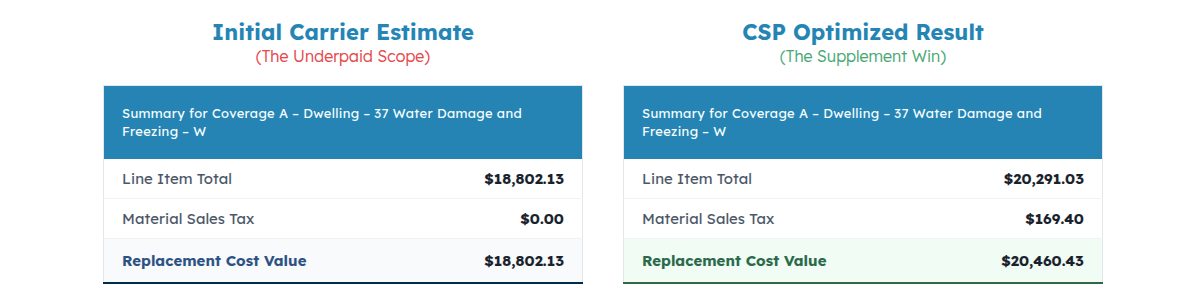
One documented before-and-after example from CSP’s water mitigation and flood supplements service involved a Coverage A – Dwelling – 37 Water Damage and Freezing loss. The initial carrier estimate totaled $18,802.13, while the optimized CSP scope reached $20,460.43, resulting in a net supplement recovery of $1,658.30.
This wasn’t a category dispute or category-upgrade situation. The water category classification was already correct.
The issue came from an underscoped drying plan that omitted IICRC S500-standard equipment days, technician labor, and supporting mitigation line items. Equipment duration, monitoring visits, and associated labor hours didn’t fully match site conditions or the actual drying timeline.
Documentation made all the difference. Moisture logs, daily equipment readings, technician notes, and environmental measurements gave CSP documented justification for every line item added to the supplement.
Every revision mapped back to documented mitigation requirements already present in the file rather than speculative additions or inflated scope.
The final result mirrors a scope-accuracy correction. So, it’s not a dramatic recovery figure.
Even modest revisions like this matter on mitigation claims because missing drying days and equipment charges can erode contractor margin and erode it fast.
Full visuals and downloadable examples are available on CSP’s Water Mitigation & Flood Supplements page.
When to Call in a Supplement Partner on Water Losses
Several warning signs point to a miscategorized or underscoped mitigation claim:
- The estimate treats a contaminated loss as Category 1
- Equipment days don’t match documented IICRC S500 drying targets.
- PPE, containment, or antimicrobial line items are missing on Category 2 or 3 losses
- Moisture mapping results extend beyond the area included in the estimate
- The 48/72-hour degradation timeline is ignored despite supporting documentation
- Revision requests halt after the first supplement submission
Disputes like these usually come down to documentation quality and technical justification. CSP’s guide on how to negotiate with insurance adjusters clarifies just how exactly mitigation teams can support drying timelines, contamination classifications, and concealed damage during supplement review.
Thanks to its water mitigation supplement service, CSP provides restoration contractors with line-by-line estimate reviews, moisture documentation analysis, Xactimate supplement preparation, and carrier-ready submissions backed by IICRC S500 standards. Drying logs, equipment usage, technician notes, and moisture mapping data document the scope revisions required by actual site conditions.
Frequently Asked Questions
What is the difference between water damage Category 1, 2, and 3?
Water damage categories describe the contamination level of the source water. Category 1 comes from a sanitary source, Category 2 contains significant contamination, and Category 3 involves gross contamination with harmful substances or pathogens.
These water damage categories are in direct correlation with demolition scope, PPE requirements, drying procedures, and disposal protocols.
How long does it take for Category 1 water to become Category 3?
Under IICRC S500 guidelines, Category 1 water can degrade to Category 2 within 48 hours and Category 3 within 72 hours under normal indoor conditions. Temperature, humidity, and material saturation can accelerate (or slow down) the deterioration timeline.
What is an example of Category 2 water damage?
Common examples of Category 2 water damage include dishwasher overflows, washing machine discharge, hydrostatic seepage, aquarium leaks, and toilet overflows containing urine only. These losses ask for more caution than clean-water events because contaminants may cause illness or discomfort through contact.
Is Category 3 water damage covered by insurance?
Many residential and commercial property policies cover sudden and accidental cat 3 water damage, though sewage backups may require additional endorsements. Flood-related losses are usually not a part of standard policies, demanding separate flood coverage. Policy language ultimately controls coverage decisions.
What is the difference between water damage category and class?
Category refers to contamination level, while class refers to evaporation load and the extent of material saturation. A class 3 water damage loss comes with significant moisture absorption across walls, ceilings, insulation, and other materials, even if the water itself isn’t Category 3.
How do adjusters determine water damage category?
Adjusters analyze the source of the loss, how long materials remained wet, environmental conditions, and the types of affected materials. Photos, moisture readings, technician notes, and contamination documentation justify the category applied to the loss.
What does Cat 3 water mean?
The cat 3 water definition refers to grossly contaminated water containing pathogens, toxins, sewage, or other hazardous substances. Cat 3 water requires full PPE, containment, removal of porous materials, and specialized disposal procedures.
Can clean water become black water?
Yes. Category 1 water, left untreated, can degrade into Category 2 and eventually Category 3 after prolonged contact with building materials and environmental contaminants. IICRC S500 recognizes this deterioration as a valid reason for category escalation during supplement review.
Final Thoughts: Get Paid for the Scope You're Actually Performing
Don’t perceive water damage categories as simple technical labels inside an estimate. They determine drying procedures, demolition scope, PPE requirements, equipment usage, and the final reimbursement attached to the job.
Restoration teams that thoroughly document source conditions, moisture levels, environmental readings, and contamination indicators place themselves in a much better position during supplement assessment and category disputes.
CSP evaluates water mitigation scopes through its Water Mitigation & Flood Supplements services to verify documented categories, drying requirements, and line items against field documentation.